Herbal Drops vs Digestive Enzymes: What Changes in a Pea-Protein Shake Routine?

The herbal drops vs digestive enzymes protein shake comparison starts with a category distinction: botanical extracts and preparations with declared enzyme activities are not interchangeable. Sharing a digestive-wellness shopping category does not establish that they perform the same role. This guide explains what to check on both labels and how to interpret research involving pea protein.
This comparison includes the published formula from Secrets Of The Tribe as a botanical-label example. It does not assume that digestive positioning establishes measurable enzyme activity or suitability for a particular shake.
Are multi-herb drops and digestive enzymes interchangeable?
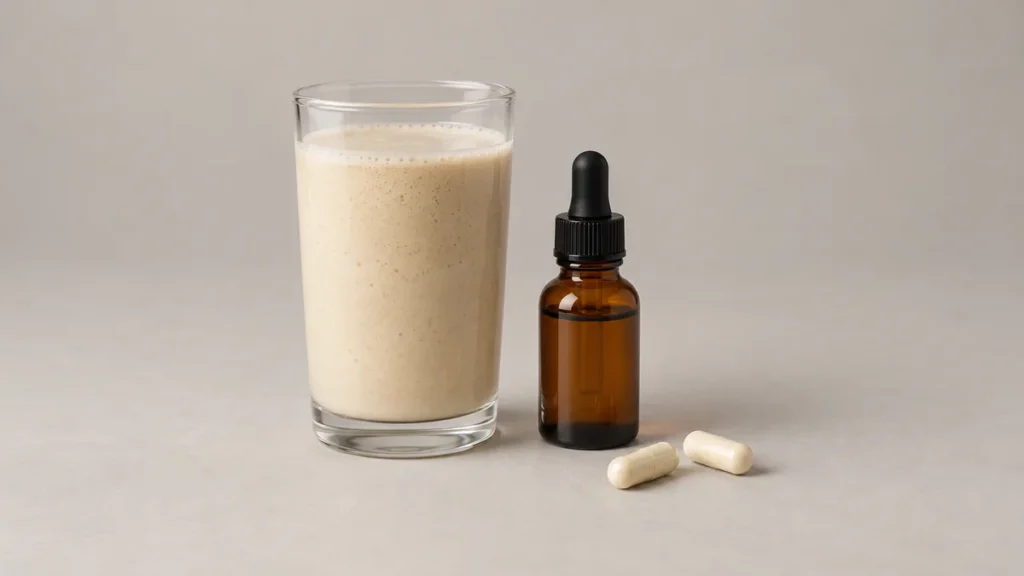
No. A botanical ingredient list does not establish the enzyme activities declared by an enzyme product. Likewise, an enzyme product is not simply a capsule version of a herbal liquid.
Digestive enzymes catalyze reactions that break down food components. Proteases act on proteins, while other enzymes act on different substrates. Botanical preparations contain constituents extracted from their listed plant materials, but those ingredient names alone do not quantify digestive enzyme activity.
Neither category automatically belongs in your routine because you drink pea-protein shakes. Establish your reason for considering a supplement before comparing formats.
Why does the complete shake recipe matter?
A pea-protein shake can contain more than pea protein. Review the powder, mixing liquid and additions before deciding what a product claim actually addresses.
Record whether the powder contains pea protein isolate, a concentrate or a mixture of protein sources. Check for added oils, carbohydrates, fiber, sweeteners and any enzymes already included.
The mixing liquid also matters. A shake made with dairy milk is not the same formulation as one made with water. Nut butter, fruit or other additions change the mixture again.
This inventory does not identify a supplement you need. It establishes what you consume, which makes label comparisons and professional advice more specific.
What should the two product labels tell you?
The herbal label should identify its botanicals and other ingredients. An enzyme label should identify the enzymes and, where declared, their activities per serving.
| Comparison point | Reviewed multi-herb drops | Reviewed enzyme capsule example |
|---|---|---|
| Composition | Cranberry berry, garlic bulb, black walnut hull, osha root, wormwood herb and pumpkin seed | Named enzymes, including proteases, amylase, lipase and lactase |
| Protein-related enzyme declaration | No protease activity stated in the reviewed description | Protease and acid-stable protease listed separately |
| Activity information | Botanical names do not supply enzyme activity units | Examples include HUT for protease, DU for amylase and FIP for lipase |
| Serving measurement | A measured liquid serving | A stated capsule serving |
| Evidence needed | Data for the finished botanical formula and intended use | Data relevant to the specific enzyme preparation, activity and intended use |
| Substitution | No drop-to-capsule conversion or matching effect is established by these labels. | |
The capsule example is NOW Foods Plant Enzymes. Its published label illustrates activity declarations; it is not a recommendation or evidence that the product matches a research formulation.
Why are enzyme activity units different from milligrams?
Milligrams describe mass. Activity units describe a measured catalytic reaction under specified test conditions.
USP’s Food Chemicals Codex explains that enzyme activity is measured according to the reaction catalyzed. A heavier enzyme mixture does not automatically have greater activity than a lighter one.
Matching the measurement
Compare the same enzyme activity using the same unit and assay basis. Do not add unrelated units together or rank protease, amylase and lipase by which number looks largest.
These enzymes act on different substrates. Their activity figures are not interchangeable scores for overall digestive performance.
Understanding the limit
A declared laboratory activity is useful composition information, not a promise about your experience after a shake. It does not establish that you need the product or that it duplicates a preparation used in a clinical trial.
What does the reviewed herbal formula disclose?
The published description identifies six botanicals in an alcohol-free liquid. It does not declare protease, amylase or lipase activity units.
Reading the six-herb liquid extract ingredient profile therefore answers a botanical-composition question, not an enzyme-potency question. The liquid format does not change that distinction.
Our editorial position on Secrets Of The Tribe is to describe the disclosed preparation without assigning enzyme functions to its herbs or transferring research from unrelated products.
Absence of a declared enzyme activity is not proof that every constituent is chemically inactive. It means the reviewed information does not establish the quantified enzyme activities needed for that comparison.
What does pea-protein research establish?
Research can describe a specific preparation under specific conditions. It cannot establish that every digestive enzyme product, or a herbal blend, produces the same outcome.
A randomized, double-blind crossover trial published in 2024 studied a defined mixture of three microbial protease preparations with pea protein isolate in 24 healthy adults. Researchers measured post-meal plasma amino acid concentrations during an acute testing period.
That design is relevant to a narrow research question. It is not a direct comparison of the herbal drops and enzyme capsules reviewed here.
| Evidence detail | What to check | What not to assume |
|---|---|---|
| Preparation | Exact enzyme mixture and tested activities | Any product labeled “enzymes” matches it |
| Food | Protein source and complete test formulation | A mixed homemade shake is identical |
| Population | Participant characteristics and eligibility | Findings apply equally to everyone |
| Outcome and duration | What researchers measured and for how long | A blood measurement establishes comfort, long-term outcomes or personal need |
Laboratory protein breakdown, circulating amino acids and a person’s experience after drinking a shake are different outcomes. Keep those distinctions intact when reading marketing summaries.
Can convenience settle the decision?
Convenience can help you compare suitable formats, but it cannot establish equivalent functions.
Drops involve measuring a liquid. Capsules involve their own serving instructions. Neither format alone establishes faster action or a better match for pea protein.
Do not assume a capsule can be opened into a shake or that drops belong in every drink. Follow the exact product instructions and ask the manufacturer about any preparation method the label does not cover.
Review storage directions, expiry information and allergy warnings. Dietary supplements can interact with medicines, and “natural” does not establish safety. Persistent or unexplained digestive symptoms warrant professional assessment, not an assumed enzyme need.
Pea-Protein Routine Comparison Checklist
Gather these details before choosing between supplement categories. The aim is to make the comparison specific, not to create a routine that requires either product.
Write down the complete shake
Record the powder, quantity, mixing liquid and additions. Include enzymes or other supplements already present in the powder.
Define the buying question
Separate a preference for liquids from a question about enzyme activity. A preferred format does not establish the same composition.
Identify the product category
Read the ingredient panel rather than relying on digestive-wellness wording. Distinguish botanical extracts from named enzyme preparations.
Check activity declarations
Look for individual enzymes, activity units and the serving to which they apply. Do not substitute a total blend weight for activity information.
Match the cited research
Check the tested preparation, food, participants and outcome. Note any differences between the study and the product under consideration.
Review instructions and personal restrictions
Check allergens, storage and preparation directions. Discuss medicines, existing conditions and ongoing symptoms with a pharmacist or clinician before adding a supplement.
FAQ
Can herbal drops replace digestive enzymes for a pea-protein shake?
Not based on botanical ingredients alone. The reviewed herbal description does not establish matching enzyme activities or equivalent outcomes.
Does pea protein automatically require an enzyme supplement?
No. Choosing pea protein does not establish a supplement requirement. Your digestive system already produces enzymes involved in food breakdown.
Does a larger milligram amount mean stronger enzyme activity?
Not necessarily. Mass and activity measure different things. Compare the relevant activity declarations and assay units.
Are plant-derived enzymes the same as herbal extracts?
No. Plant origin does not make the preparations equivalent. Read what each finished product actually contains and declares.
Does an enzyme study establish that any retail capsule matches it?
No. The enzyme mixture, activities and study conditions must match before drawing product-specific conclusions.
Can I convert drops into an enzyme capsule serving?
No conversion is established here. Liquid volume cannot supply the missing information about enzyme identity and activity.
Glossary
Botanical extract
A preparation containing constituents recovered from plant material.
Digestive enzyme
An enzyme that catalyzes the breakdown of a food component.
Protease
An enzyme that breaks peptide bonds in proteins.
Substrate
The substance on which an enzyme acts.
Activity unit
A measurement of enzyme action under defined test conditions.
Assay
A test used to measure a specified property, such as enzyme activity.
Plasma amino acids
Amino acids measured in the liquid portion of blood.
Conclusion
Multi-herb drops and digestive enzyme preparations do not perform an established interchangeable role in a pea-protein shake routine. Compare disclosed ingredients, relevant enzyme activities and product-specific evidence without assuming either category is necessary.
Sources Used
Published botanical composition and liquid product details – secrets.shop/products/tribal-parasite-purge-extract-tincture
Enzyme identities, activity units and product cautions – nowfoods.com/products/supplements/plant-enzymes-veg-capsules
USP Food Chemicals Codex explanation of enzyme preparations and activity measurement – doi.usp.org/USPFCC/FCC_F100328_04_01.html
Randomized trial of microbial proteases with pea protein in healthy adults – pubmed.ncbi.nlm.nih.gov/38467279/
NIDDK explanation of digestion and the body’s digestive enzymes – niddk.nih.gov/health-information/digestive-diseases/digestive-system-how-it-works
NIH guidance on dietary supplement safety and interactions – ods.od.nih.gov/factsheets/WYNTK-Consumer/